Monday, November 9, 2009

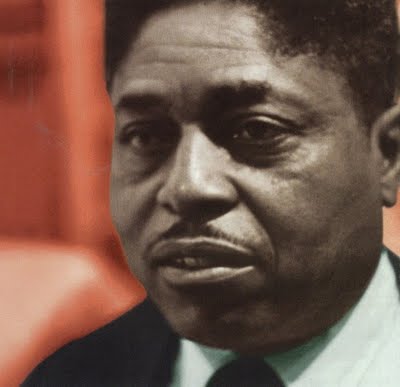
Smokey Hogg

Andrew "Smokey" Hogg- Deep Ellum Rambler


Album Review:
"This comprehensive retrospective of Hogg's 1947-1951 work for Modern Records gathers 27 tracks, including the Top Ten R&B hits "Little School Girl" (a Sonny Boy Williamson composition) and "Long Tall Mama," as well as ten previously unissued cuts. If only in hindsight, Hogg at this juncture can be seen to be a link between rural blues and citified R&B, using some accompanying musicians and some electric guitar, but not always going whole-hog into a full-band sound. His phrasing, too, is still grounded in country-blues, but pushed toward more modern forms by some heavily rhythmic backing and barrelhouse piano. It's on the ragged side (pleasantly so) as just-post-World War II blues-cum-R&B goes, the arrangements sometimes giving the impression of being crafted on the spot, though Hogg's vocals are relaxed and authoritative. Sometimes it feels like a link between a Texas bluesman like Lightnin' Hopkins and the West Coast R&B of the late '40s and early '50s; the Modern label, of course, was at the forefront of the Western R&B/blues crossover mix. It's rather similar-sounding in one dose, as most single-artist compilations of material from this time on the Modern label are. Yet it's not as homogenous as some such anthologies are, in large degree because of Hogg's likable vocal persona. Almost everything was written by Hogg except, oddly enough, those two big hits, "Little School Girl" and "Long Tall Mama.""
-Allmusic.com

Download Link: http://www.zshare.net/download/6825470679cda492/

Saturday, November 7, 2009

Prime Jack Dupree

Champion Jack Dupree- Junker's Blues (The Blues Collection Vol.59)


Biography:
"A formidable contender in the ring before he shifted his focus to pounding the piano instead, Champion Jack Dupree often injected his lyrics with a rowdy sense of down-home humor. But there was nothing lighthearted about his rock-solid way with a boogie; when he shouted "Shake Baby Shake," the entire room had no choice but to acquiesce.

Dupree was notoriously vague about his beginnings, claiming in some interviews that his parents died in a fire set by the Ku Klux Klan, at other times saying that the blaze was accidental. Whatever the circumstances of the tragic conflagration, Dupree grew up in New Orleans' Colored Waifs' Home for Boys (Louis Armstrong also spent his formative years there). Learning his trade from barrelhouse 88s ace Willie "Drive 'em Down" Hall, Dupree left the Crescent City in 1930 for Chicago and then Detroit. By 1935, he was boxing professionally in Indianapolis, battling in an estimated 107 bouts.

In 1940, Dupree made his recording debut for Chicago A&R man extraordinaire Lester Melrose and OKeh Records. Dupree's 1940-1941 output for the Columbia subsidiary exhibited a strong New Orleans tinge despite the Chicago surroundings; his driving "Junker's Blues" was later cleaned up as Fats Domino's 1949 debut, "The Fat Man." After a stretch in the Navy during World War II (he was a Japanese P.O.W. for two years), Dupree decided tickling the 88s beat pugilism any old day. He spent most of his time in New York and quickly became a prolific recording artist, cutting for Continental, Joe Davis, Alert, Apollo, and Red Robin (where he cut a blasting "Shim Sham Shimmy" in 1953), often in the company of Brownie McGhee. Contracts meant little; Dupree masqueraded as Brother Blues on Abbey, Lightnin' Jr. on Empire, and the truly imaginative Meat Head Johnson for Gotham and Apex.

King Records corralled Dupree in 1953 and held onto him through 1955 (the year he enjoyed his only R&B chart hit, the relaxed "Walking the Blues.") Dupree's King output rates with his very best; the romping "Mail Order Woman," "Let the Doorbell Ring," and "Big Leg Emma's" contrasting with the rural "Me and My Mule" (Dupree's vocal on the latter emphasizing a harelip speech impediment for politically incorrect pseudo-comic effect).

After a year on RCA's Groove and Vik subsidiaries, Dupree made a masterpiece LP for Atlantic. 1958's Blues From the Gutter is a magnificent testament to Dupree's barrelhouse background, boasting marvelous readings of "Stack-O-Lee," "Junker's Blues," and "Frankie & Johnny" beside the risqué "Nasty Boogie." Dupree was one of the first bluesmen to leave his native country for a less racially polarized European existence in 1959. He lived in a variety of countries overseas, continuing to record prolifically for Storyville, British Decca (with John Mayall and Eric Clapton lending a hand at a 1966 date), and many other firms.

Perhaps sensing his own mortality, Dupree returned to New Orleans in 1990 for his first visit in 36 years. While there, he played the Jazz & Heritage Festival and laid down a zesty album for Bullseye Blues, Back Home in New Orleans. Two more albums of new material were captured by the company the next year prior to the pianist's death in January of 1992. Jack Dupree was a champ to the very end."
-Allmusic.com

Download Link: http://www.zshare.net/download/68156592a37bd26e/

Thursday, November 5, 2009

Bill Broonzy, Part 2

Big Bill Broonzy- Part 2 (1937-1940)


Album Review:
"The second volume in JSP's Big Bill Broonzy retrospective is four discs long, covering the bluesman's years in Chicago and New York. What is astonishing is that there are 100 tracks here. While it's true that there are many alternate takes for the sake of the historical record, nonetheless, when combined with volume one, this accounts for a prolific output by the singer and guitarist. Each disc is fully annotated with session information. Some of the musicians on these sessions include Blind John Davis, Washboard Sam, Punch Miller, Black Bob, and Ransom Knowling. The sound is good to very good indeed, as the music here has been completely remastered. Presentation is sparse but more than serviceable, and as always with JSP, the price is excellent. Neil Slaven wrote biographical liner notes for the set."
-Allmusic.com

Download Link: http://www.zshare.net/download/6805170874242102/

Wednesday, November 4, 2009

Charlie Spand Dreams The Blues

Charlie Spand- Dreaming The Blues: The Best Of Charlie Spand


Album Review:
"Some folks say that piano man Charlie Spand was born in Elljay, GA, a small town in the Appalachian foothills north of Atlanta. That statement, like most of the information associated with this artist, is based upon research and speculation. What's known for sure is that Charlie Spand was one of several heavy-hitting blues, boogie-woogie and barrelhouse pianists who performed on Brady and Hastings Streets in Detroit, MI during the '20s. It is also known that in 1929 Spand moved to Chicago where he began hanging out and gigging with guitarist Blind Blake. Most verifiable of all is the fact that between June 1929 and September 1931 Spand recorded 24 sides for the Paramount label in Richmond IN, Chicago IL and Grafton, WI. In 1992 the Document reissue label released Spand's Complete Paramounts in chronological order. In 2002, the folks at Yazoo brought out Dreaming the Blues, a chronologically shuffled survey of these same recordings with noticeably improved sound quality. Yazoo did not include "Tired Woman Blues," an alternate take of "Got to Have My Sweetbread" or an incomplete breakdown of "Levee Man Blues." Yazoo did include Spand's spoken introduction from a song on a Paramount's blues sampler, "Hometown Skiffle," originally released in 1929 and reissued in 1997 by Black Swan Records, a division of the GHB Jazz Foundation, Inc., in New Orleans, LA. The Paramount recordings of Charlie Spand are refreshingly honest and real. Seven of these tracks (from the Richmond sessions that took place during the summer of 1929) have guitar accompaniments; most of these are attributed to Blind Blake, who rattles off a bit of friendly conversation on "Hastings Street." The only other Charlie Spand recordings known to exist are eight sides cut for the Okeh label in June of 1940. The producers at Document have vowed to reissue these rare sides "on CD at a later date.""
-Allmusic.com

Download Link: http://www.zshare.net/download/679633843070f3a2/

Monday, November 2, 2009

Old Timey Pickin'

George Pegram & Walter "Red" Parham- Pickin' & Blowin'


Biography:
"George Franklin Pegram was born and raised in Guilford County, a farming community that was rich in traditional music. Growing up as a teenager, the musician purchased his first Silvertone banjo for $15. He also met Zack Whitaker, a local promoter who organized fiddlers' conventions and showcases while Pegram was growing up. Also influenced by his uncle Clyde Pegram, George Pegram began perfecting the "double-thumbing" style of banjo playing, a three-finger movement that used single notes. At the age of 26, Pegram married Dorothy Louise Dick in Guilford County, then moved to Statesville. Upon entering the navy during the Second World War, Pegram lost one eye during the attack on Pearl Harbor. After working a variety of odd jobs in sawmills and furniture factories, the musician met Bascom Lamar Lunsford, a promoter of folk and "mountain" dance festivals. Needing additional acts to fill various folk festivals in North Carolina, Lunsford signed Pegram and recorded some of his material. Throughout the 1950s, he performed with Clegg Garner, Okie Mountain Boys and Corbett Bennett and His Mountain Dudes. In 1955, Pegram played with Walter "Red" Parhorn and more touring and performing continued. In 1957, Kenneth Goldstein recorded the duo for Riverside Records. Known for his dynamic and exciting live show, Pegram won a series of annual awards at the Galax Fiddlers' Convention, including the Outstanding Individual Performer in both 1966 and 1969. In 1970, he released his self-titled debut album. The album was the first album ever released on the Boston-based Rounder Records. Pegram continued playing until 1974, with the Asheville Folk Festival that year being his last performance. In September 1974, Pegram died from bone cancer. In 1995, Rounder Records celebrated its silver anniversary by re-releasing the album with six additional tracks."
-Allmusic.com

Download Link: http://www.zshare.net/download/678430361781dec6/

Saturday, October 31, 2009

Fine Recording From Sunnyland Slim

Sunnyland Slim- Blues Masters, Vol. 8


Biograpy:
"Exhibiting truly amazing longevity that was commensurate with his powerful, imposing physical build, Sunnyland Slim's status as a beloved Chicago piano patriarch endured long after most of his peers had perished. For more than 50 years, the towering Sunnyland had rumbled the ivories around the Windy City, playing with virtually every local luminary imaginable and backing the great majority in the studio at one time or another.

He was born Albert Luandrew in Mississippi and received his early training on a pump organ. After entertaining at juke joints and movie houses in the Delta, Luandrew made Memphis his homebase during the late '20s, playing along Beale Street and hanging out with the likes of Little Brother Montgomery and Ma Rainey.

He adopted his colorful stage name from the title of one of his best-known songs, the mournful "Sunnyland Train." (The downbeat piece immortalized the speed and deadly power of a St. Louis-to-Memphis locomotive that mowed down numerous people unfortunate enough to cross its tracks at the wrong instant.)

Slim moved to Chicago in 1939 and set up shop as an in-demand piano man, playing for a spell with John Lee "Sonny Boy" Williamson before waxing eight sides for RCA Victor in 1947 under the somewhat misleading handle of "Doctor Clayton's Buddy." If it hadn't been for the helpful Sunnyland, Muddy Waters may not have found his way onto Chess; it was at the pianist's 1947 session for Aristocrat that the Chess brothers made Waters's acquaintance.

Aristocrat (which issued his harrowing "Johnson Machine Gun") was but one of a myriad of labels that Sunnyland recorded for between 1948 and 1956: Hytone, Opera, Chance, Tempo-Tone, Mercury, Apollo, JOB, Regal, Vee-Jay (unissued), Blue Lake, Club 51, and Cobra all cut dates on Slim, whose vocals thundered with the same resonant authority as his 88s. In addition, his distinctive playing enlivened hundreds of sessions by other artists during the same timeframe.

In 1960, Sunnyland Slim traveled to Englewood Cliffs, NJ, to cut his debut LP for Prestige's Bluesville subsidiary with King Curtis supplying diamond-hard tenor sax breaks on many cuts. The album, Slim's Shout, ranks as one of his finest, with definitive renditions of the pianist's "The Devil Is a Busy Man," "Shake It," "Brownskin Woman," and "It's You Baby."

Like a deep-rooted tree, Sunnyland Slim persevered despite the passing decades. For a time, he helmed his own label, Airway Records. As late as 1985, he made a fine set for the Red Beans logo, Chicago Jump, backed by the same crack combo that shared the stage with him every Sunday evening at a popular North side club called B.L.U.E.S. for some 12 years.

There were times when the pianist fell seriously ill, but he always defied the odds and returned to action, warbling his trademark Woody Woodpecker chortle and kicking off one more exultant slow blues as he had done for the previous half century. Finally, after a calamitous fall on the ice coming home from a gig led to numerous complications, Sunnyland Slim finally died of kidney failure in 1995. He's sorely missed."
-Allmusic.com

Download Link: http://www.zshare.net/download/6778445383ae68ea/

Thursday, October 29, 2009

John Jacob Niles, Folk Singer

John Jacob Niles- An Evening With John Jacob Niles


Biography:
"Music played an important part in the early life of John Jacob Niles, and he would spend his life collecting, composing, and performing folk songs. By the age of 15 he had begun collecting songs in the Appalachian Mountains, a habit he would continue while serving as a ferry pilot in the U.S. Air Corps during World War I. Niles remained in France after the war, studying music at the Universite de Lyon and the Schola Cantorum in Paris. He would continue his studies for two more years at the Cincinnati Conservatory of Music upon returning to the United States. In 1921, he came to New York where he met the singer Marion Kerby. Kerby shared his love of folk music, so the two decided to work as a team, traveling throughout Europe and the United States.

Niles collected folk songs in the Southwest while working as a guide and chauffeur for photographer Doris Ulmann. During the '20s and '30s, he began publishing collections of folk songs, including Singing Soldiers (1927), Songs My Mother Never Taught Me (1929), and Songs of the Hill-folk (1934). In the '30s he began to perform solo, traveling widely and singing at high schools, churches, and colleges. He dressed in bright-colored shirts, wore corduroys, and sang in a striking, high falsetto. Barry Alfonso, recalling the first time he heard Niles on record, wrote, "Out of my stereo came his startling, other-worldly voice, the sound of someone enraptured -- or maybe possessed. He seemed to embody his dire ballad, rather than to merely perform it."

Niles wrote a number of classic folk songs that are often mistaken for traditional material, including, "Black Is the Color of My True Love's Hair," "Go 'Way From My Window," and "I Wonder as I Wander." He recorded numerous albums, including Early American Ballads (1939) and American Folk Lore (1941). He also composed more formal music, writing the oratorio "Lamentation," which would receive its first performance at the Indiana State Teachers College in 1951. Between 1967 and 1970 he would compose a work based on the poetry of Thomas Merton titled "The Niles-Merton Songs." The Songs of John Jacob Niles was published in 1975 and Niles would continue to perform publicly until two years before his death in 1980. Part Renaissance man, part traveling minstrel, Niles left an invaluable body of recordings, folk song collections, and compositions behind. His work has greatly aided the preservation and continued vitality of American folk culture."
-Allmusic.com

Download Link: http://www.zshare.net/download/67673600be4e36bd/